
Working with multiple suppliers means managing different timelines, quality standards, and communication protocols. Each handoff adds days or weeks to your development cycle. Parts move from the laser cutting facility to the welding shop, then to surface treatment, then to assembly, accumulating transit time, receiving inspections, and queue time at every step. Multi-vendor arrangements also create accountability gaps: when a quality issue emerges, determining who is responsible becomes a time-consuming exercise that holds everything up. Each vendor represents a potential point of failure, where material shortages, capacity constraints, or operational issues at any single supplier can stall your entire project.
With laser cutting, laser welding, laser marking, electropolishing, passivation, CNC machining, cleanroom assembly, finished product assembly and packaging all under one roof, parts never leave our facility during processing. There is never any question about who is responsible. A dedicated GTI representative maintains close and consistent contact throughout your project, from initial prototyping through serial production. With over 20 years and zero supply chain interruptions, full inventory management means your project stays on schedule regardless of outside pressures.
5 Ways a One-Stop Medical Device Manufacturer Accelerates Your Time-to-Market.
Time-to-market can make or break a medical device startup. According to the Focused Ultrasound Foundation, bringing a new medical device to market typically takes three to seven years or more.
Each month of delay costs companies revenue, competitive positioning, and investor confidence. A PA Consulting Group survey found that 56% of medical device executives ranked reducing time-to-market as their top concern in product development.
Yet the traditional multi-vendor manufacturing model creates delays that are often invisible until projects fall behind schedule. Juggling separate suppliers for laser cutting, welding, surface treatments, assembly, and packaging creates constant handoffs at every stage.
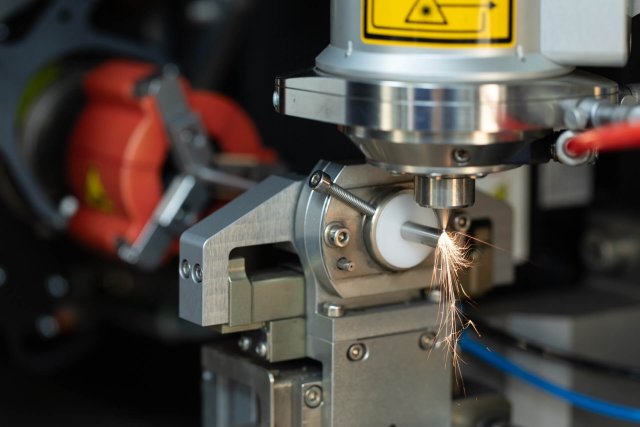
A vertically integrated, one-stop manufacturer that controls the entire production chain under one roof offers a different path forward. Here’s how:
From 24 Months to 10: The Acclarent Project
In 2018, the R&D team at Acclarent, a Johnson & Johnson company specializing in ENT medical products, came to GTI to manufacture a prototype for a device designed to extract fluid from the sinuses. Their original work plan was scheduled to take 24 to 36 months. With all processes in-house, GTI delivered prototype models every ten days for review and improvement. The project was completed in just ten months, with costs reduced considerably as a result.
When parts travel between facilities for different processes, each round of changes adds transit time. Communication delays between vendors slow down the feedback that drives design improvements. Engineers at the cutting facility may not understand the welding requirements, and welders may not be aware of the assembly needs.
With all processes under one roof, GTI’s engineering team can move from laser cutting to welding to surface treatment to testing within the same facility, often within the same day. This enables rapid feedback and collaborative problem-solving directly with your team.
Taking Ownership of the Unexpected: Canadian Dental Navigation System
A Canadian startup came to GTI with a navigation system for dental implant surgeries that required new manufacturing processes. GTI developed these from scratch, engineering custom solutions for a system that combined mechanical components, electronics, optical cameras, and CNC-machined parts. GIT then took on full project management, handling procurement, assembling, packaging, and shipping through to delivery.
Design changes late in development are far more expensive than early adjustments. Projects relying on multiple vendors often surface manufacturability issues only after production processes have been established. By that point, making changes requires rework across multiple facilities, each adding cost and time.
GTI’s engineering phase includes Design for Manufacturability (DFM) analysis and cost reduction strategies from day one. Because we control the entire manufacturing chain, we can identify potential issues across cutting, welding, surface treatment, and assembly together, before they turn into expensive problems.
Early Optimisation, Real Savings: Acclarent DFM Results
The Acclarent project achieved significant cost reduction through GTI’s focused and efficient approach. By optimizing designs for integrated processes early in development, costly rework was avoided later in the project.
Quality issues often come up at the handoff points between vendors. What passes quality checks at one facility may not meet the standards of the next, and by the time these gaps surface, time and money have already been spent on parts that fall short. Tracking down the source of a quality issue across multiple vendors can take weeks.
GTI’s ISO 13485 and ISO 9001 certified quality management system covers every process under one roof. In-house testing includes tensile testing, 4-axis OGP optical measurement, Af temperature testing for Nitinol, dye penetrant testing, peel and burst testing, and metallurgical cross-sections. Every shipment includes a Certificate of Conformance (COC), Certificate of Analysis (COA), and Certificate of Testing (COT).
From Incubator to FDA Approval: Meniscus Surgical Tool
GTI managed quality control across every stage of an Israeli startup’s meniscus surgical tool, from the early days of prototype production through manufacturing process development, clinical trial preparation, and FDA approval. The same standards applied throughout the entire process, with no handoffs between vendors to let problems slip through. GTI still manufactures components for the product today.
FDA submissions and international regulatory approvals require comprehensive documentation of manufacturing processes, quality systems, and validation protocols. Coordinating all of this across multiple vendors is complex and easy to get wrong. Each supplier works with their own systems, formats, and protocols, and any gaps in that coordination can push your approval back.
As an ISO 13485 and ISO 9001 certified manufacturer with FDA registration, GTI maintains a unified quality management system that covers all processes. This means consistent documentation, consistent protocols, and a single point of contact for regulatory support.
Writing the Playbook: FDA Documentation Support
The Israeli startup behind the meniscus surgical tool needed support well beyond manufacturing. GTI wrote the protocols, manufacturing specifications, and assembly instructions included in the company’s FDA submission, guiding the team through design freeze, validation, and compliance requirements from incubator stage through to approval and serial production.GTI took the same approach with the Canadian dental navigation system, developing the assembly and operational instructions used directly in the client’s FDA submission. One manufacturing partner, one documentation system, no gaps.
The Bottom Line
Medical device development is inherently complex. Regulatory requirements are stringent, quality standards are non-negotiable, and investors expect results. A one-stop manufacturer removes the back-and-forth, accountability gaps, and supply chain risks that come with managing multiple vendors. The result is faster development, clearer communication, lower costs, and a shorter path to market.